双侧大量气胸患者可以高压氧治疗吗?Can patients with bilateral massive pneumothorax undergo hyperbaric oxygen therapy?
咱们先看CT 扫描图片。
Let's take a look at the CT scan images first.
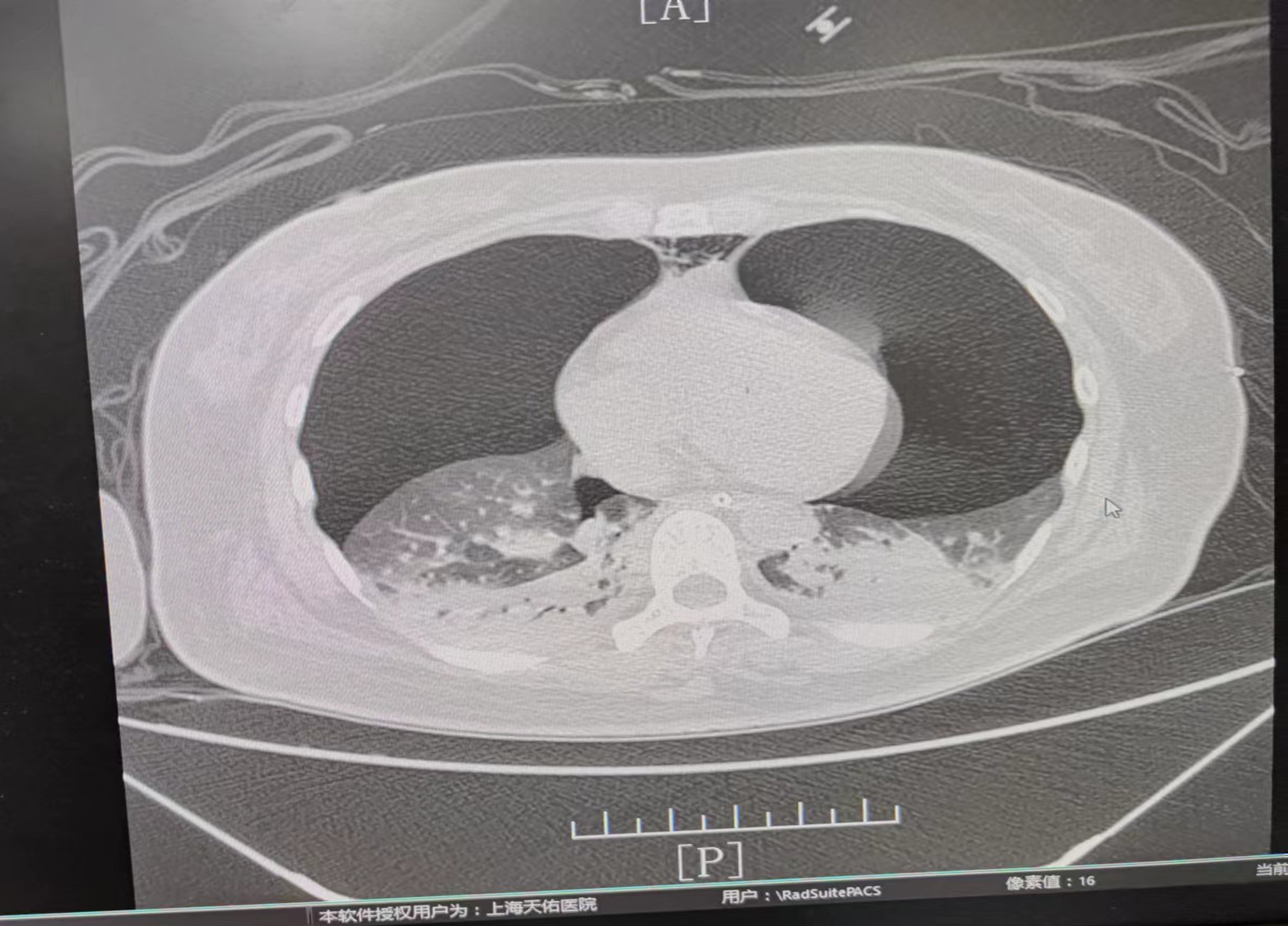
只有张力性气胸才可能造成这样的肺压缩,像这样的气胸病人如果不处理,直接高压氧治疗会怎么样?
Only a tension pneumothorax can cause such pulmonary compression.What would happen if such a patient with pneumothorax were nothing done about it and directly subjected to hyperbaric oxygen therapy?
这是一个 49 岁的中年女性,因肺部占位拟进行肺部肿块切除术,术前准备时行颈静脉置管术,术后数分钟发现患者心跳呼吸骤停,当时立即给予气管插管、呼吸机辅助通气、胸外按压,5 分钟后,心脏复苏成功,仍无自主呼吸,CT 显示脑水肿明显。手术医生立即通过院方与我院高压氧脑复苏中心联系,要求高压氧综合治疗。并提出要求,先做高压氧治疗然后再去病房。因高压氧舱位置紧张,两天后患者转入我院并开始高压氧治疗。
This is a 49-year-old middle-aged woman who was scheduled for a lung tumor resection due to a lung mass. During preoperative preparation, a neck vein catheterization was performed. A few minutes after the operation, the patient's heart and breathing suddenly stopped. At that time, immediate tracheal intubation, ventilator-assisted ventilation, and chest compression were administered. Five minutes later, cardiac resuscitation was successful, but there was still no spontaneous breathing. CT showed significant cerebral edema. The surgeon immediately contacted our hospital's hyperbaric oxygen cerebral resuscitation center and requested comprehensive hyperbaric oxygen treatment. It was also requested that the treatment be carried out first in the hyperbaric oxygen chamber and then transferred to the ward. Because there are no hospital beds, the patient was transferred to our hospital two days later and began hyperbaric oxygen treatment.
我们选择的治疗方案是加压 20 分钟,在 2.4 ATA稳压 95 分钟,减压 20 分钟。
The treatment plan we chose was 20 minutes of pressurization, maintaining pressure at 2.4 ATA for 95 minutes, and then depressurization for 20 minutes.
高压氧治疗过程中,发现患者血氧饱和度时而不到 100%(一般来说,高压氧治疗过程中,若无特殊情况,病人的血氧饱和度均应在100%),查找原因时发现,患者双侧呼吸音低,双侧胸部叩诊鼓音,双侧胸廓膨隆明显,皮肤表面紧绷发亮,颈部检查发现气管居中,初步判断患者发生气胸,随即通知舱外人员传送胸腔穿刺包进高压氧舱,若有必要随时进行胸腔穿刺闭式引流,结果整个治疗过程中血氧饱和度始终在 90% 以上。
During hyperbaric oxygen therapy, it was found that the patient‘s blood oxygen saturation was occasionally less than 100% (Generally speaking,during hyperbaric oxygen therapy, the patient’s blood oxygen saturation should be 100% unless there are special circumstances). The cause was investigated and it was discovered that the bilateral breath sounds were low, the bilateral chest percussion was tympanic, the bilateral thoracic cavities were significantly expanded, and the skin surface was tight and bright. During the neck examination, the trachea was found to be centered. It was initially judged that the patient had pneumothorax. Immediately, the personnel outside the chamber were notified to deliver the thoracic puncture kit into the chamber. If necessary, thoracic puncture with closed drainage would be performed at any time. As a result, the blood oxygen saturation remained above 90% throughout the treatment process.
出舱以后立即去 CT 室进行胸部急诊 CT 扫描,结果发现双侧大量气胸,双肺压缩 80%~70%(如上图所示)。
After leaving the chamber, an chest CT scan was immediately performed in the CT room. It was found that there was a large amount of pneumothorax on both sides, with bilateral lung compression ranging from 80% to 70% (as shown in the figure above).
气胸是什么时候发生的呢?是穿刺的时候?是复苏的时候?是运送的时候?还是高压氧治疗的时候?事后经过讨论,虽然不能完全排除其他时间段发生气胸的可能性,穿刺时发生的可能性最大,也就是说这样的一个气胸患者也做了一次高压氧治疗。
When did the pneumothorax occur? Was it during the puncture? During the resuscitation? During the transportation? Or during the hyperbaric oxygen treatment? After discussion, although it was impossible to completely rule out the possibility of pneumothorax occurring at other times, the possibility of it occurring during the puncture was the greatest. That is to say, such a patient with pneumothorax also received one round of hyperbaric oxygen treatment.
返回病房后立即准备双侧胸腔穿刺闭式引流。请看图片,如果在左侧穿,由于左侧压力的减低,纵膈会向左侧移动;如果从右侧穿,纵膈将向右侧移动。纵膈这样的大幅度摆动,有可能会引发心跳骤停,为了避免纵膈大幅摆动导致的心跳骤停,我们选择双侧胸腔同时穿刺的方法。
在主任的号令下,两个医生同时进行胸腔穿刺,整个穿刺过程进行顺利,请看视频:
After returning to the ward, bilateral thoracentesis and closed drainage were immediately prepared. Please see the picture. If punctured on the left side, due to the reduction of pressure on the left side, the mediastinum would move to the left; if punctured on the right side, the mediastinum would move to the right. Such a significant movement of the mediastinum might cause cardiac arrest. To avoid cardiac arrest caused by such a significant movement of the mediastinum, we chose the method of puncturing both thoracic cavities simultaneously.
Under the order of the director, two doctors simultaneously performed thoracentesis. The entire puncture process was smooth. Please see the video:
接下来的高压氧治疗是在呼吸机辅助通气,升压药维持循环,双侧胸腔闭式引流的情况下进行的。
The subsequent hyperbaric oxygen treatment was carried out under the condition of ventilator-assisted ventilation, pressor drugs to maintain circulation, and bilateral thoracic closed drainage.